 CloseEase Blog
Most client onboarding questionnaires are too long, ask things the client already told you, and arrive as an attachment nobody fills in. A good one is short, specific to your work, and takes the client ten minutes. Here's what goes in it.
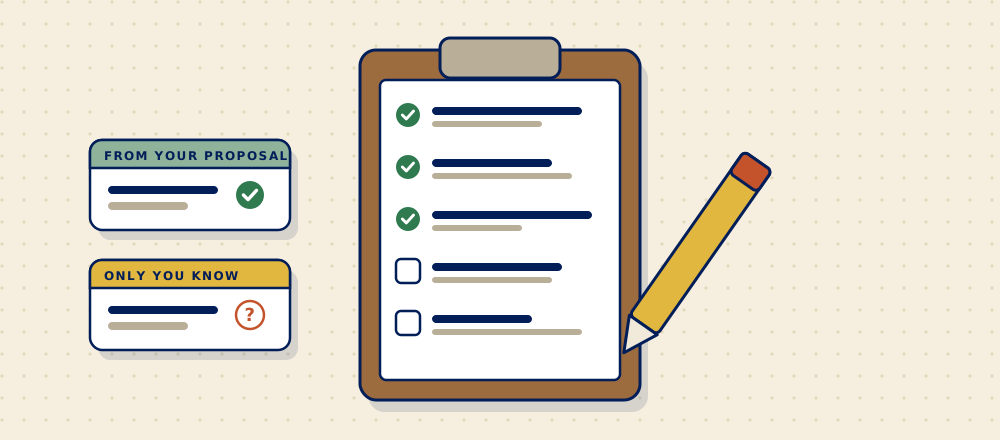
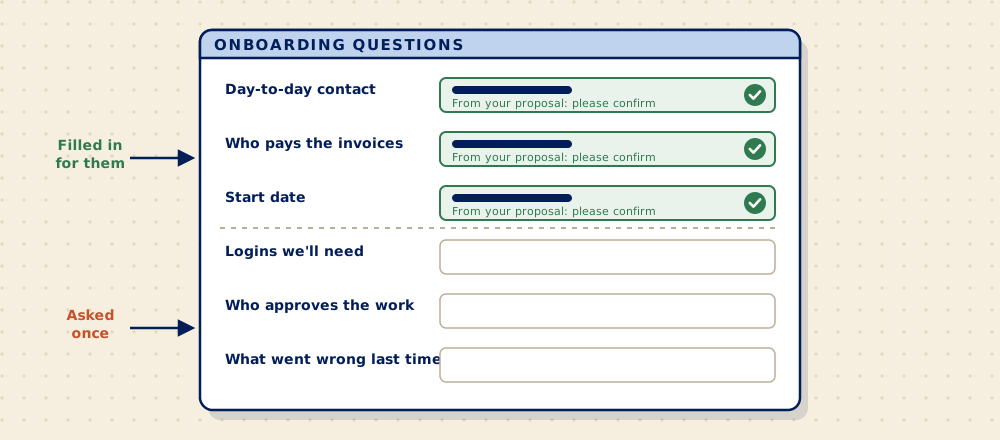
Short answerA client onboarding questionnaire should only ask for what you need to start the work and didn't already learn in the sale: who's who on the client's side, the access you need, the files and information you need, how decisions and approvals work, the key dates, and what a good result looks like to them. Fill in what you already know from the proposal and ask the client to confirm it, instead of asking again.
What questions should a client onboarding questionnaire ask?
Group the questions by what they unlock. Here's a version you can copy and trim to your work.
People
- Who is your day-to-day contact, and how do they prefer to be reached?
- Who has the final say on decisions about this work?
- Who else needs to be kept in the loop, and on what?
- Who should invoices go to?
Access
- Which accounts, systems or folders will we need, and who can give us access?
- Is there an approval process or security review we need to go through first?
Files and information
- What existing material should we start from? (Brand files, past reports, data, templates.)
- Is there anything we should know about that isn't written down anywhere?
Decisions and approvals
- How many rounds of review do you usually need, and who's involved?
- How quickly can you usually turn around an approval?
Dates
- Are there deadlines, launches, board meetings or holidays we should plan around?
- Is anyone key going to be away in the next two months?
What good looks like
- Three months from now, what would make you say this was worth it?
- What went wrong the last time you worked with someone on this?
That last question is the most useful one on the list. People tend to give a straight answer, and it tells you exactly what to avoid.
What should you add for an agency, a consultancy or a recruiting firm?
| If you're | Add questions about |
|---|---|
| An agency | Brand guidelines and files, logins for the website, ad and social accounts, who approves creative, and any legal or compliance review |
| A consultancy | Stakeholders and their roles, what data you'll need and who owns it, confidentiality requirements, and how findings should be presented |
| A recruiting firm | The role, the salary range, the hiring manager, the interview steps, who gives feedback on candidates and how fast |
What shouldn't a client onboarding questionnaire ask?
- Anything you already know. If it's in the proposal or the call notes, fill it in and ask them to confirm. Asking again tells the client nobody was listening.
- Essay questions. "Tell us about your business" gets either nothing or three pages. Ask the specific thing you need.
- Questions you won't use. If nobody on your side will read the answer before kickoff, cut it.
- Everything at once, for every client. A one-off project and a year-long retainer don't need the same form.
How long should a client onboarding questionnaire be?
As short as the work allows. A good target is something your client can finish in about ten minutes without going to look things up, plus a separate list of files and logins they can send when they have them. If it's longer than that, it's probably asking for things you won't need until later, and those can wait.
Should it be a form, a document or a call?
| Format | Good for | Watch out for |
|---|---|---|
| Online form | Getting answers in a consistent shape, sending them straight to your tools, showing what's still missing | Feeling impersonal if it's the only thing the client gets |
| Shared document | Clients who like to write freely, or several people answering | Answers in different places, and someone has to copy them out |
| Onboarding call | Complex work where questions lead to more questions | Notes that only one person took, and details that never make it into your system |
Many firms use a form for the facts and a short call for the "what good looks like" questions. Whatever you choose, the answers should land in one place your team works from.
What happens to the answers?
This is where most questionnaires fall down. The client fills it in, and then someone on your side retypes the answers into the CRM, the project tracker and the invoicing tool. Data entry, meaning moving information from one app to another, came top of the most dreaded tasks in Zapier's survey of 1,000 workers at small and medium businesses.1 If that's happening to you, here's why your team types the same information in three places.
Once the answers are in, check them against the ready-to-start checklist before kickoff. It's free, with no sign-up, and it covers the 15 things that should be in place between a client signing and the work starting.
Questions people ask
When should you send the client onboarding questionnaire?
With your welcome email, within one business day of the client signing. The longer you wait, the longer it is before the work can start.
How many questions should a client onboarding questionnaire have?
Usually 10 to 20, grouped by topic. The client should be able to finish it in about ten minutes. Files and logins can be a separate list they send when ready.
What if the client doesn't fill it in?
Send one friendly reminder that lists only what's still missing, and offer a 15-minute call to go through it together. If it's still stuck, it's worth asking whether the right person on their side has it.
Is a client onboarding questionnaire the same as a client intake form?
They overlap. An intake form usually comes before the sale, to decide whether you're a fit. An onboarding questionnaire comes after, to collect what you need to start the work.
Should every client get the same questionnaire?
Keep one core set of questions, then add a short section for each type of work you do. A small one-off project shouldn't get the same form as a year-long engagement.
Sources
- Zapier, "Knowledge workers' most dreaded tasks", April 2021. Survey of 1,000 US knowledge workers at businesses with fewer than 250 employees, run by OnePoll. Zapier sells automation software.