 CloseEase Blog
Search for how long client onboarding should take and you'll find answers anywhere from a few days to three months. Both can be right, because they're measuring different things. Here's how to work out what's right for your firm, and how to tell how long yours really takes.
Short answerFor most agencies, consultancies and recruiting firms, getting from a signed client to the work starting should take days, often within one to two weeks. The 30 to 90 day figures you'll see online usually describe software rollouts measured to the client's "first success", which includes training. In a service firm, what makes onboarding long is almost always waiting for information, not doing work.
Why do the published answers vary so much?
Because they measure from and to different points. Onboarding software companies often quote 30 to 90 days, measured from the welcome email to the client's first real result, with setup and training in between.1 That's a fair number for rolling out a software platform across a client's company.
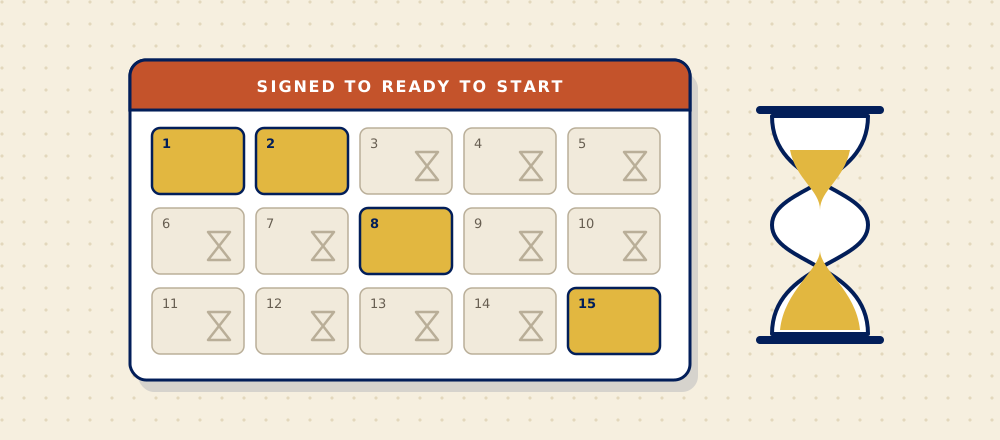
For a service firm, the more useful measure is shorter and more concrete: days from signed to ready to start. That's the stretch you control, the one your client feels, and the one where most of the waste sits.
What actually takes the time?
Mostly waiting. The work in onboarding (writing a handoff note, setting up the client, a kickoff) adds up to a few hours. The calendar time comes from the gaps: waiting for a logo file, for a login, for someone to approve a start date, for your own team to notice something's missing.
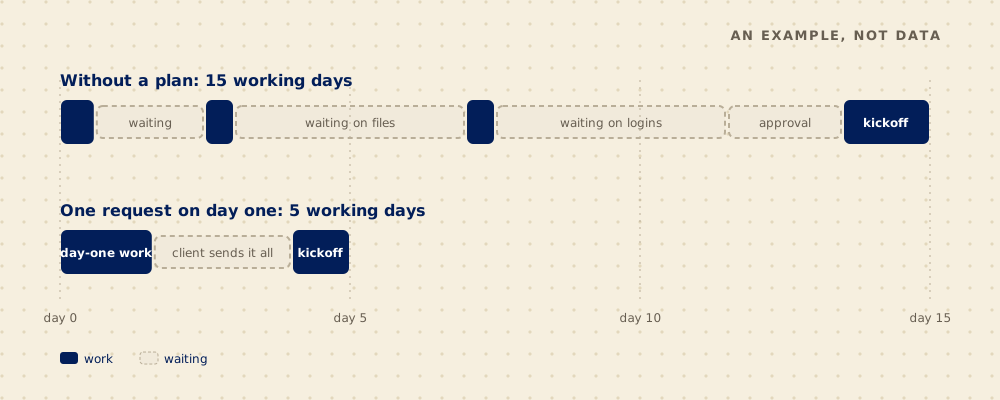
That's why the fastest fix is rarely working harder. It's asking for everything in one request, on day one, and starting your own setup at the same time instead of after.
How do you measure how long your onboarding really takes?
Take your last five new clients and fill in a table like this one. It takes about half an hour, and it's usually more revealing than anyone expects.
| Client | Date signed | Date work started | Working days | What you waited on longest |
|---|---|---|---|---|
| Client A | ||||
| Client B | ||||
| Client C | ||||
| Client D | ||||
| Client E |
Copy this into a spreadsheet. The last column matters more than the average.
If the same thing shows up in the last column more than once, that's your fix. It's often access (logins, permissions), files from the client, or an internal step like setting up billing that waits for one busy person.
How do you make client onboarding faster?
- Send one request on day one. Everything you need from the client, in one list, with the welcome email. Not a new email each time you spot a gap. Here's what to put in it.
- Fill in what you already know. Ask the client to confirm details from the proposal instead of typing them again.
- Set up your side in parallel. Your CRM, invoicing and project tracker can be ready before the client's files arrive.
- Give it one owner. One named person who knows what's ready and what's missing for each new client.
- Check before you start. A short ready-to-start check catches the gaps before kickoff, which is a much better time than week three.
When is a longer onboarding fine?
When the waiting is real work on the client's side. A consultancy that needs a security review before it can see a client's data, or a firm whose client has a formal procurement process, may need a few weeks, and that's nobody's fault. The point is to know which waiting is necessary and which is just nobody chasing.
And the start does matter to clients: in one survey, 86% said they'd be more likely to stay loyal to a business that invests in onboarding.2 It was a small survey, but the logic is hard to argue with. The first two weeks are when a new client decides whether they chose well.
If your gap between signed and started is longer than it should be, our client onboarding page shows how we find where it stalls and fix it.
Questions people ask
What's a good client onboarding time for an agency?
For most agency projects, one to two weeks from signed to the work starting is a reasonable target. If it regularly takes longer, look at what you're waiting on: it's usually files, logins or approvals from the client.
When does client onboarding start and end?
It starts the moment the client signs and ends when the work can start: the people doing it have what they need, and the client knows what happens next. Kickoff is the last step.
Why does client onboarding take so long?
Mostly because of waiting, not work. Requests go out one at a time, nobody owns the gap between sales and delivery, and internal setup waits until the client's information arrives.
How do you measure client onboarding time?
Count the working days from the date the client signed to the date the work started, for your last five clients, and write down what you waited on longest for each. The repeat answers are where to start.
Does faster onboarding really keep clients?
Clients say it matters: in a Wyzowl survey, 86% said they'd be more loyal to a business that invests in onboarding. A quick, organised start is also when a new client decides whether they chose well.
Sources
- GUIDEcx, "How long should the client onboarding process take?" GUIDEcx sells client onboarding software.
- Wyzowl, Customer Onboarding Statistics 2020. Survey of 216 customers. Wyzowl makes onboarding videos.